₹16 Lakh, 420 Guests, Two Families: How the Sharmas Planned a Wedding Without a Money Fight
A wedding story with six simple money habits: one agreed budget, a 10% surprise fund, a written who-pays split, one payment log, plates from RSVPs and a same-day shagun list.

From Mr. Hoot’s Money Stories. A story based on situations many families face. The names, people and numbers are made up to illustrate the ideas. This is general information, not financial advice.
Two weeks after her engagement, Priya Sharma had a notebook full of numbers, three WhatsApp groups that never stopped buzzing, and a growing feeling that nobody actually knew how much the wedding was going to cost.
The budget was ₹16 lakh. Around 420 people would be invited. Five functions, over three days. And two families, the Sharmas and the Mehtas, who liked each other very much and very much wanted to keep it that way.
“Money is where weddings get tense,” her mother said. “Not because people are bad. Because nobody writes anything down.”
So Priya, the bride and the family’s self-appointed money manager, decided to write everything down. Here is what she did, and what any family can borrow from it.
1. One number, agreed before anything was booked
Before a single advance was paid, both families sat together over chai and agreed on one figure: ₹16 lakh for everything. Venue, food, decoration, photos, outfits, travel, gifts. Everything.
It sounds obvious. But most budget fights start because each side has a different number in their head. Once the number was agreed out loud, every later decision became a simple question: does this fit inside ₹16 lakh?
2. Ten per cent set aside for surprises
Priya kept ₹1,60,000 (10% of the budget) aside as a “surprise fund” and did not plan to spend it on anything.
The surprises came, as they always do. Rain was forecast for the mehendi, so a covered tent was added (₹45,000). More relatives decided to stay over, so extra hotel rooms were needed (₹40,000). And two outfits needed last-minute alterations and a replacement (₹35,000). Together that was ₹1,20,000, all of it paid from the surprise fund instead of from panic.
3. Who pays what, written down before the first payment
The families agreed that shared costs would be split 60:40, Sharmas to Mehtas. It was written on one page that everyone could see, along with a simple rule: every payment gets logged with who paid it.
By the end, the wedding had cost ₹14,80,000 in total. The Sharmas had paid ₹9,10,000 and the Mehtas ₹5,70,000. Their fair shares were ₹8,88,000 (60%) and ₹5,92,000 (40%). So the settle-up was one clear line: the Mehtas transfer ₹22,000 to the Sharmas. No guessing, no awkward conversations, no “I think we paid more”.
4. One payment log instead of five chats
Every advance, every balance and every cash payment went into one list: date, vendor, amount, who paid, and how. Next to each vendor sat the agreed price, the amount paid so far and the next due date.
Twice this caught a mistake. Once a vendor asked for a balance that had already been paid in cash. Once a second advance was about to go to a decorator by mistake. Both times, the log settled it in seconds.
5. Plates counted from replies, not guesses
The caterer suggested booking 450 plates for the reception “to be safe”. Priya checked the RSVPs instead. 340 people had confirmed. She added a 5% buffer for surprise guests and booked 357 plates.
At ₹1,100 a plate, those 93 plates nobody needed would have cost ₹1,02,300. That one check paid for most of the surprises above.
6. Every shagun recorded the same day
Gifts and shagun envelopes were noted down that evening (who gave, what, and for which function) instead of being opened in a rush a week later. When it was time to say thank you, nobody was forgotten, and the family knew exactly what to give back at those families’ future celebrations.
How it ended
The wedding finished ₹1,20,000 under the ₹16 lakh budget, with every vendor paid, both families settled up, and a thank-you list ready. The money conversations, the ones everyone was worried about, took about ten minutes in total.
“The best part,” Priya said later, “was that nobody had to trust my memory. It was all just there.”
The checklist you can borrow
- Agree one total budget with everyone involved before booking anything.
- Keep about 10% aside for surprises, and don’t plan to spend it.
- Write down who pays what share before the first payment, not after the last.
- Keep one payment log: date, vendor, amount, who paid, how.
- Book food from confirmed replies plus a small buffer, not from the invite list.
- Record gifts and shagun on the same day you receive them.
The tool behind the story
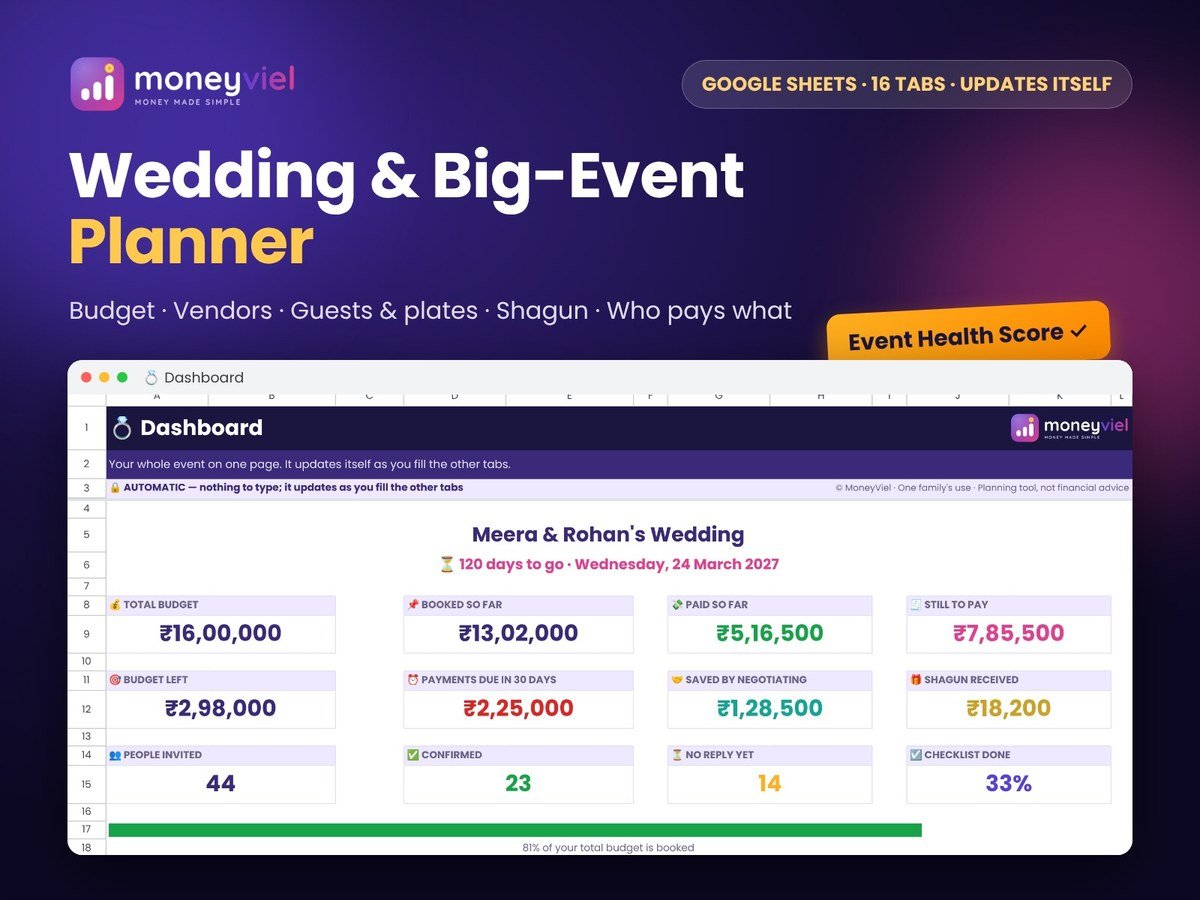
Priya’s notebook-and-WhatsApp system is exactly why we built the MoneyViel Wedding & Big-Event Planner. It’s one Google Sheet that does all of the above for you: a live dashboard with a countdown, budget and payments due; vendor and payment tracking with due-date alerts; guest list and RSVPs with exact plate counts for every function; a Who Pays What tab with a settle-up line; a gifts and shagun register; and an Event Health Score out of 100.
Watch the 3-minute demo:
It works for weddings, engagements, birthdays, anniversaries and other family events, and comes with an example version, a blank version and an “any currency” edition for families planning from abroad. You need a free Google account. See it in the MoneyViel shop →
MoneyViel shares general money education, not financial advice. For questions about the planner, write to us and we reply within 72 hours.
💌 Enjoyed this? Get simple money tips in your inbox, free. Subscribe →
🛍️ New: printable money kits for kids, and smart planners for grown-ups (Excel + Google Sheets). Visit the shop →